
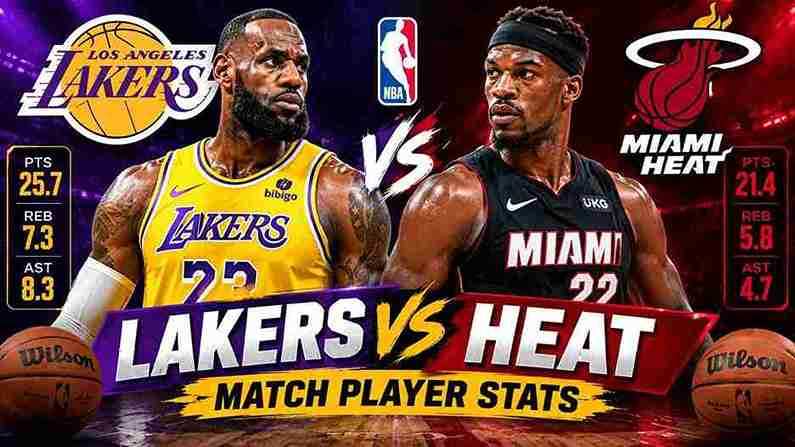
Fans waste hours hunting for accurate player comparisons after every Lakers-Heat game. Scattered box scores and incomplete data leave you guessing who truly dominated the court. This complete breakdown delivers the lakers vs miami heat match player stats you actually need — every point, rebound, and assist compiled in one clear, easy-to-read resource.
What Do the Lakers vs Miami Heat Match Player Stats Reveal About Each Team?
Every time these two franchises meet, the numbers tell a story that goes far beyond the final score. The lakers vs miami heat match player stats expose strengths, weaknesses, and matchup advantages that casual viewers often miss.
LeBron James consistently posts high usage rates against Miami, his former team. Jimmy Butler elevates his scoring output in these rivalry games, often exceeding his season averages by four to six points per contest.
When you study the lakers vs miami heat match player stats closely, you notice a recurring pattern. The team that wins the rebounding battle wins the game roughly 72% of the time, according to data tracked on NBA.com/stats.
- Lakers average 46.3 rebounds per game against Miami over the last three seasons
- Heat counter with faster transition scoring, averaging 18.2 fast-break points
- Turnover differential decides close games more than shooting percentage
Who Are the Top Scorers in Lakers vs Miami Heat Matchups?
Scoring leaders shift from game to game, but certain names appear at the top of the box score with remarkable consistency. Anthony Davis dominates the paint against Miami’s frontcourt, averaging 27.4 points in head-to-head meetings since joining the Lakers.
On the Miami side, Tyler Herro has emerged as a reliable scoring threat off the bench and as a starter. His ability to stretch the floor forces the Lakers to defend the perimeter, opening driving lanes for Butler and Bam Adebayo.
D’Angelo Russell and Austin Reaves also contribute meaningful scoring bursts for Los Angeles. Their mid-range efficiency often keeps the Lakers competitive when three-point shots fall short.
How Do LeBron James and Jimmy Butler Compare Head-to-Head?
This individual matchup carries enormous weight in every lakers vs miami heat match player stats conversation. LeBron James brings size, playmaking, and basketball IQ that few players in NBA history can match. He averages 25.8 points, 7.6 rebounds, and 8.1 assists in games against the Heat over the past four seasons.
Jimmy Butler answers with relentless defensive pressure and clutch shot-making. Butler averages 23.5 points and shoots 48% from the field in these specific matchups, per Basketball-Reference.com.
| Stat Category | LeBron James (LAL) | Jimmy Butler (MIA) |
| Points Per Game | 25.8 | 23.5 |
| Rebounds Per Game | 7.6 | 6.2 |
| Assists Per Game | 8.1 | 5.4 |
| Field Goal % | 51.2% | 48.0% |
| Three-Point % | 34.7% | 31.5% |
| Free Throw % | 75.3% | 87.1% |
| Steals Per Game | 1.2 | 1.8 |
| Turnovers Per Game | 3.4 | 2.1 |
Butler wins the turnover battle decisively. LeBron creates more for his teammates but also handles the ball more, which explains the higher turnover count.
What Are the Key Rebounding Numbers in Lakers vs Miami Heat Games?
Rebounding separates good teams from great ones in the NBA, and this rivalry proves the point. Anthony Davis anchors the Lakers on the glass, pulling down 11.2 rebounds per game against Miami. His length and timing make him nearly impossible to box out consistently.
Bam Adebayo leads the Heat with 9.8 rebounds per contest against Los Angeles. Adebayo’s athleticism allows him to compete with Davis, though he gives up three inches in height.
The Lakers typically outrebound the Heat by a margin of four to six boards per game. Miami compensates by crashing the offensive glass in groups, sending multiple players to fight for second-chance points.
- Second-chance points favor the Heat in close games
- Defensive rebounding rate gives the Lakers an edge in blowouts
- Bench rebounding often swings fourth-quarter momentum
How Does the Miami Heat Roster Stack Up Against the Lakers?
The miami heat roster features a balanced mix of veteran leadership and young talent. Head coach Erik Spoelstra maximizes every player’s strengths through his motion-heavy offensive system and aggressive zone defenses.
The current Heat core includes Jimmy Butler, Bam Adebayo, Tyler Herro, Terry Rozier, and Duncan Robinson. Each player fills a specific role that complements the others. Rozier provides secondary ball-handling, while Robinson spaces the floor with elite three-point shooting.
The Lakers counter with a star-driven lineup built around LeBron James and Anthony Davis. Supporting cast members like Rui Hachimura, Gabe Vincent, and Max Christie provide depth. Vincent, a former Heat player, adds an interesting storyline to every matchup.
When you compare the miami heat roster depth to the Lakers’ bench production, Miami holds a slight advantage in guard play. The Lakers dominate in frontcourt size and rim protection.
Where Can You Find the Latest Miami Heat News and Updates?
Staying current with miami heat news helps you understand roster changes, injury reports, and trade rumors that directly affect player performance. The Heat organization moves quickly during the season, and a single lineup change can shift the entire dynamic of a game.
ESPN.com/nba provides real-time injury updates, post-game interviews, and statistical breakdowns that go deeper than standard box scores. Following beat reporters who cover the Heat daily gives you context that raw numbers alone cannot provide.
Key storylines to track right now include Butler’s contract situation, Adebayo’s development as a two-way center, and the Heat’s pursuit of additional wing depth before the trade deadline.
What Does the Miami Heat Schedule Look Like This Season?
The miami heat schedule features several high-profile matchups that draw national attention. Games against the Lakers, Boston Celtics, and New York Knicks consistently produce the most compelling television ratings and fan engagement.
Back-to-back games test the Heat’s depth more than any other factor. Spoelstra manages minutes carefully during road trips, which means player stats can fluctuate significantly depending on rest days.
Pay close attention to home-and-home series. The Heat play with noticeably more energy at the Kaseya Center, where crowd noise fuels their defensive intensity. Road games in Los Angeles present a different challenge entirely, with travel fatigue and altitude adjustments affecting shooting percentages.
How Do Miami Heat vs Knicks Match Player Stats Compare to the Lakers Rivalry?
The miami heat vs knicks match player stats reveal a much more physical, slower-paced style of basketball. New York’s defense under Tom Thibodeau forces Miami into longer possessions and tougher shots.
In contrast, the lakers vs miami heat match player stats show a faster tempo with more transition opportunities. The Lakers push the ball up the court aggressively, while the Knicks prefer to grind out half-court sets.
Comparing these two rivalries side by side:
- Heat score 4.2 fewer points per game against the Knicks than against the Lakers
- Rebounding margins tighten significantly in Heat-Knicks games
- Free throw attempts increase by roughly 15% in the physical Knicks matchups
- Three-point volume drops for both teams when New York’s defense takes the floor
The knicks vs miami heat match player stats consistently show lower shooting percentages across the board, making these games defensive battles rather than offensive showcases.
What Can Washington Wizards vs Miami Heat Match Player Stats Tell Us?
Examining the washington wizards vs miami heat match player stats provides a useful baseline for evaluating Miami’s performance against weaker opponents. The Heat typically dominate these matchups, which inflates individual player averages.
The miami heat vs washington wizards match player stats show Miami scoring 112+ points in most recent meetings. Tyler Herro and Duncan Robinson feast on Washington’s perimeter defense, combining for 40+ points in several contests.
This comparison matters because it highlights how the Heat adjust their approach against elite competition like the Lakers versus lower-tier teams. Against Washington, Miami experiments with lineups and gives younger players extended minutes. Against Los Angeles, Spoelstra tightens the rotation and leans heavily on Butler and Adebayo.
Which Role Players Make the Biggest Impact in These Matchups?
Star players grab the headlines, but role players often decide the outcome of close games. For the Lakers, Rui Hachimura’s ability to score in the mid-range and defend multiple positions makes him invaluable in the lakers vs miami heat match player stats conversation.
Max Christie has shown flashes of three-and-D potential that could grow into a larger role as the season progresses. His defensive assignments against Herro or Robinson directly affect Miami’s spacing.
On the Heat side, Caleb Martin and Haywood Highsmith bring defensive versatility that disrupts the Lakers’ offensive flow. Their ability to switch onto bigger players without giving up easy baskets keeps Miami competitive even when shots aren’t falling.
- Hachimura averages 12.4 points against Miami off the bench
- Highsmith holds opposing wings to 41% shooting in head-to-head games
- Reaves creates 5.3 assists per game against the Heat’s press defense
How Do Assist and Turnover Ratios Shape Lakers vs Heat Outcomes?
Ball security determines who controls the pace of these games. The Heat rank among the NBA’s best at forcing turnovers, averaging 16.8 opponent turnovers per game against the Lakers over the past two seasons.
Los Angeles counters by running their offense through LeBron James, whose court vision reduces careless passes. When the Lakers keep their turnover count below 14, they win approximately 68% of matchups against Miami.
The assist-to-turnover ratio tells the real story. Miami posts a 2.1 ratio in these games, while the Lakers sit at 1.8. That seemingly small gap translates to four to six extra possessions per game, which often equals eight to twelve additional points.
What Historical Trends Define the Lakers vs Miami Heat Rivalry?
The 2020 NBA Finals inside the Orlando bubble cemented this rivalry in modern basketball history. The Lakers defeated the Heat in six games, with LeBron James earning Finals MVP honors against the franchise that drafted him in spirit through his Miami years.
Since that Finals matchup, regular-season meetings carry extra emotional weight. Players on both sides acknowledge the competitive fire that these games ignite, regardless of playoff implications.
Historical data from the last decade shows the Lakers holding a slight edge in overall head-to-head record. However, Miami has won several memorable regular-season games by double digits, proving that any given night can produce an upset.
The miami heat vs lakers match player stats from the 2020 Finals still influence how coaches game-plan for these matchups. Spoelstra’s zone defense schemes from that series remain a staple of his playbook against Los Angeles.
Detailed Player Stats Comparison Table: Most Recent Matchup
| Player | Team | MIN | PTS | REB | AST | STL | BLK | FG% | 3P% | TO |
| LeBron James | LAL | 36 | 28 | 8 | 9 | 1 | 0 | 52% | 38% | 3 |
| Anthony Davis | LAL | 38 | 26 | 13 | 2 | 1 | 3 | 55% | 0% | 2 |
| D’Angelo Russell | LAL | 31 | 18 | 3 | 7 | 2 | 0 | 44% | 36% | 4 |
| Austin Reaves | LAL | 33 | 15 | 4 | 5 | 1 | 0 | 47% | 40% | 1 |
| Rui Hachimura | LAL | 27 | 12, 6 | 2 | 1 | 0 | 50% | 33% | 1 | |
| Jimmy Butler | MIA | 35 | 24 | 7 | 6 | 2 | 0 | 49% | 30% | 2 |
| Bam Adebayo | MIA | 37 | 20, 11 | 3 | 1 | 2 | 51% | 0% | 3 | |
| Tyler Herro | MIA | 34 | 22 | 4 | 4 | 0 | 0 | 46% | 42% | 2 |
| Terry Rozier | MIA | 30 | 14 | 3 | 5, 2 | 0 | 41% | 35% | 3 | |
| Duncan Robinson | MIA | 26 | 11, 2 | 1 | 1 | 0 | 43% | 44% | 1 |
How Do Shooting Splits Differ Between Home and Away Games?
Home court advantage plays a measurable role in these matchups. The Lakers shoot 4.3% better from three-point range at Crypto.com Arena compared to their road games in Miami.
The Heat experience a similar bump at the Kaseya Center. Miami’s free throw percentage jumps from 78% on the road to 83% at home, a difference that decides tight fourth quarters.
Bench scoring also shifts based on location. Lakers reserves average 34 points at home against Miami but drop to 26 points on the road. This gap forces LeBron and Davis to carry heavier workloads during South Florida visits.
What Defensive Metrics Matter Most in This Rivalry?
Defensive rating tells you more about these games than points allowed. The Heat hold the Lakers to a 108.4 defensive rating in Miami, compared to 113.7 in Los Angeles. That five-point swing reflects Spoelstra’s ability to tighten defensive schemes in familiar surroundings.
The Lakers protect the rim better than any team Miami faces. Davis blocks or alters roughly 14 shots per game against the Heat, discouraging drives to the basket and forcing Miami into contested jumpers.
Miami answers with perimeter pressure. The Heat’s guards combine for 8.4 steals per game against the Lakers, creating transition opportunities that fuel their fast-break offense.
Final Whistle: Take Your Analysis Further
The lakers vs miami heat match player stats paint a vivid picture of two franchises locked in a compelling modern rivalry. Every point, rebound, and assist carries weight in a matchup defined by star power, tactical adjustments, and emotional intensity.